Showing posts with label Background. Show all posts

Saturday, 12 September 2015

Behind the Scenes at Vinnies

By Ms Frugal Ears: who writes about frugal and simple living, parenting and low-cost recipes. She is a compulsive op-shopper, even when trying to declutter and embrace mindful minimalism.

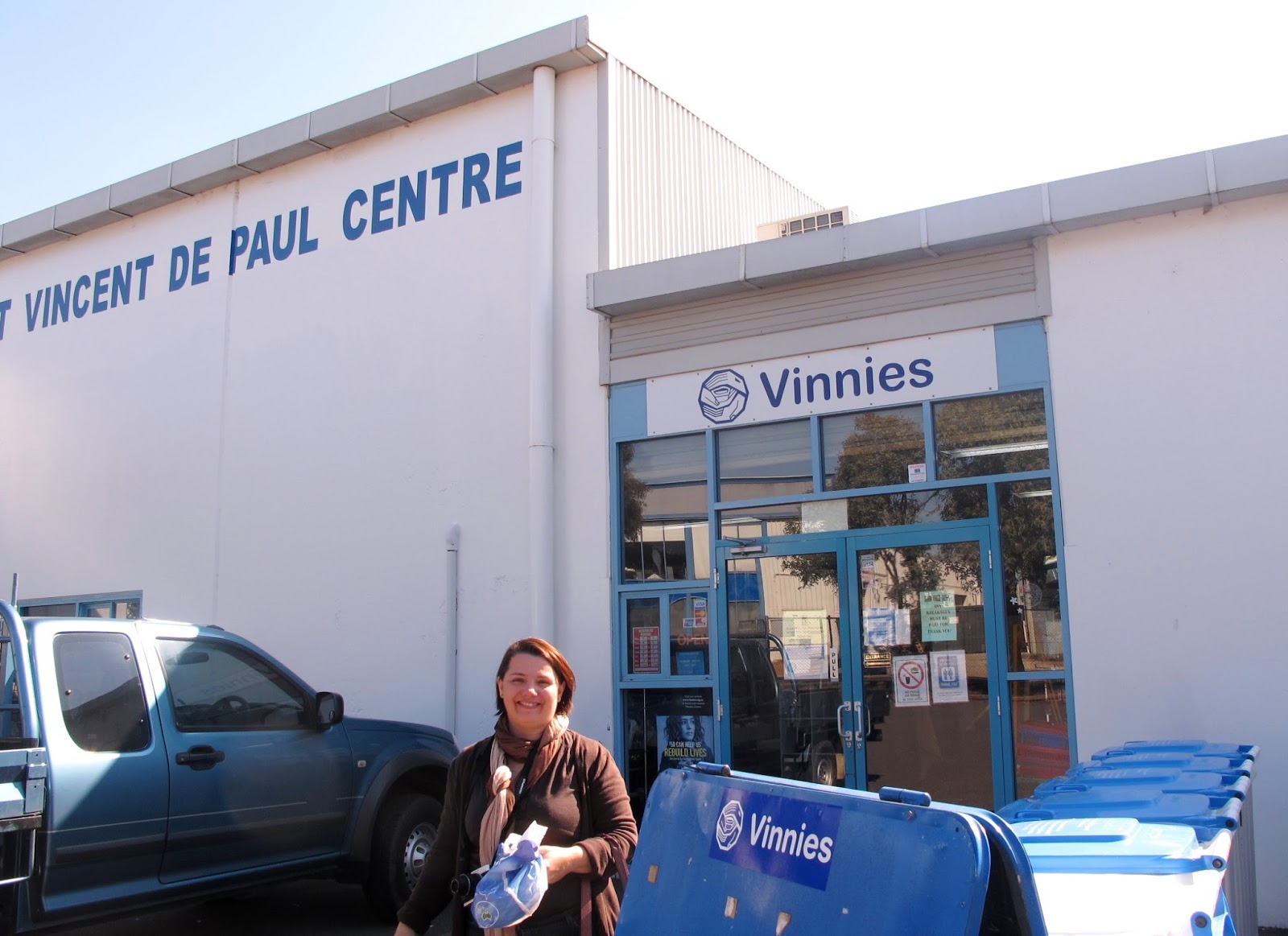
I love op-shopping. Okay, perhaps I am a bit obsessed. And I have always wondered how charity shops manage the sheer bulk of donations that come in. How do they stock a store so that everything is neat and ordered? How do they price items? So I was thrilled to participate in a behind-the-scenes tour of the Mitchell Distribution Centre of the St Vincent de Paul Society (Vinnies) along with fellow I Op Therefore I Am member The Shopping Sherpa.
Woman standing outside the front of Vinnies Mitchell.
Photo by The Shopping Sherpa
Our tour guide was Gary Crowder, Area Manager for the Mitchell Distribution Centre and Dickson Centre; which encompasses the full time management of the warehouse. He didn't look like he worked in an op-shop. Well, I don’t know what I expected but I am used to being greeted by kind older ladies. 
Woman and man talking in front of an office door.
Photo by The Shopping Sherpa
Gary is ex-military, a snappy dresser and clearly good with logistics. When we saw the scale of the operation, we realized why his ex-military skills must come in handy.
Woman and man talking next to a number of large bins.
Photo by The Shopping Sherpa
Vinnies Mitchell handles three units: a retail shop, a sorting facility and a service unit. The Mitchell facility is responsible for sorting donations for five Canberra stores to include Mitchell. Belconnen and Tuggeranong stores do a certain amount of self-sorting, but none of the other stores have the facilities to process all donations themselves. Vinnies trucks visit the stores on Mondays, Wednesdays and Fridays, and service the general public on Tuesday and Thursdays.

First step on our tour was a walk through the retail shop. I found it hard to move through the retail shop without pausing to look at things. I wanted to try on the jewellery, flick through the women’s clothing rack, search for craft items and books and check out the children’s wear. Oh, that vintage fake-fur coat! That Tupperware butter dish! The children’s DVDs! This instinctive need to touch things and take them home only intensified when we visited the stock out the back. ‘Just pretend it is like a museum,’ whispered Anna-Maria. ‘No touching.’

You may not realise that there is a retail outlet in Mitchell. I didn't actually know there was one before our visit. It is hidden in a side street behind some adult establishments, one street back from the Salvos op shop. For several years it was not open to the public, operating only as a sorting facility and warehouse, but it re-opened for business a few years ago.
A man points out something in front a sorting bins and a pallet rack full of large bags of clothing.
Photo by The Shopping Sherpa
Man looking at a pallet rack holding large bags full of clothing.
Photo by The Shopping Sherpa
The sorting centre receives bags containing up to 15 kg in unsorted donations from its stores. These are stored at a shed on its premises until the bags are sorted (more on that to come). Vinnies Mitchell workers are able to sort between 100 and 120 bags per day. They also receive other donations from drop-off bins and centres, including at the Mitchell centre itself.

Wearing gloves (cloth or vinyl gloves – not latex as some people have allergies), workers open up a bag and then sort into three piles: A-grade (shop stock), B-grade and items unusable (rubbish). Vinnies has a ‘ban list’ of products that it is prohibited from selling, or that it is unable to sell (e.g. it does not sell electronic items). Most items are good quality, but some bags contain soiled or dangerous items. Vinnies policy is that if the bag smells funny or does not look safe, dispose of it. Safety of worker is paramount.
A bin full of textiles and books next to a sorting table. On the table are a blue and a white laundry basket, and behind it are two rubbish skips.
Photo by The Shopping Sherpa
A-grade items are placed in either a blue or a white laundry basket, depending on whether the items are suitable for winter or summer clothing. When they are full, the A-grade baskets are then taken to another section of the sorting area, where they are sorted into labelled boxes.
Man holding up an item of clothing in front of a run of labelled cardboard boxes.
Photo by The Shopping Sherpa
Man putting an item of clothing into one of a run of labelled cardboard boxes.
Photo by The Shopping Sherpa
A run of labelled cardboard boxes.
Photo by The Shopping Sherpa
I was amazed at the effort Vinnies put into packaging items according to category, for example men’s ties, women’s belts, women’s vests, women’s dresses, children’s toys and so on. This system means that it is easy for shops to place an order when they are low on a certain type of item: for example they can request more women’s summer t-shirts and a box is easily located and sent to them.

B-grade items include clothing that is faded or needs minor repairs, or other items in less than top condition. These items are on-sold in bulk bales to textile companies.

What does Vinnies Mitchell receive the most of in donations? A large proportion of items—up to 85%—consist of women’s clothes. It receives much less menswear and there is always a demand for good quality men’s clothing. “Men in Canberra tend to wear tailored suits, and then wear them until they are nearly worn out,” explained Gary. “We get a lot of suit jackets that we can sell, but there are not nearly as many pants. And there is not much in the way of casual wear, either.”

We ventured through another ‘do not enter’ door into the inner sanctum of the sorting facility. Here there were tall pallet racks filled with large sacks of unsorted items, piles of books, tins of jewellery, and odds and ends.
Man standing next to a pallet rack full of bags of clothing in a large warehouse.
Photo by The Shopping Sherpa
Woman looking at a trolley containing a stack of labelled cardboard cartons.
Photo by The Shopping Sherpa
Woman taking a photograph of a man holding a plastic bin of goods so she can see into it.
Photo by The Shopping Sherpa
 All items sold have to comply with Australian legislation. For example, if an items is faulty then a customer can return it and request a refund. And DVDs can only be sold with the correct Australian classification. Many of the classifications have changed—for example there is now a MA15+ category—so Vinnes has a volunteer who comes in during the week to search the DVD titles online and label them with new classification stickers.
A man holding a DVD cover in front of a pile of other DVD covers.
Photo by Ms Frugal Ears
I noticed a pile of crutches and walkers stored on the mezzanine level of the warehouse. Gary explained that they provide these items to customers if they ask; they do not display them as they find that some people purchase and then resell for profit.

We thought we’d seen everything, but there was more. Gary took us out the back and into a large shed, where sacks of unsorted material received from Vinnies stores were kept. The shed houses anywhere between 2,500 and 3,000 unsorted bags at any time. “My aim is to ensure we have at least one and a half months worth of goods to stock Vinnies stores in storage, in case donations dry up for any reason” said Gary. The forklift drivers had a system for sorting the goods so that they are stored chronologically.
Woman and man talking in a large shed, in front of pallet racks holding large bags of clothing.
Photo by The Shopping Sherpa
A man checking the label on a large bag of clothing on a pallet rack.
Photo by The Shopping Sherpa
And finally, there was a warehouse across the road. The warehouse held boxes of goods that had been labelled and packaged in the sorting centre. 
Rows of stacked and labelled cardboard cartons in a warehouse.
Photo by The Shopping Sherpa
Beside the roller door was an order that had already been prepared for the Vinnies Phillip store. Once a store orders what it needs, warehouse workers locate the relevant boxes in the warehouse and then make a stack of them, ready to load onto the truck and transport.
A pile of cartons stacked up next to a roller door in a warehouse.
Photo by Ms Frugal Ears
The warehouse also contained some furniture. We admired a funky green-and-black-striped retro sofa, and a brown hipster-style sofa. 
A man arranging the back cushions of a green, fawn and black striped sofa in a warehouse.
Photo by Ms Frugal Ears
But this furniture was not destined for Vinnies stores. “Around 80% of our furniture goes to people in need,” said Gary. “Homelessness is a real problem in Canberra. And since most of the people we gift furniture to live in small apartments, it’s a challenge to find items that are small enough to fit.” Vinnies buys new foam mattresses to go with the beds it gives these people, to ensure that the bedding is hygienic and safe.
A stack of foam mattresses in plastic packaging.
Photo by Ms Frugal Ears
The thing that impressed me the most about Vinnies Mitchell Distribution Centre was the commitment to quality. Items were treated respectfully, and a lot of care went into the sorting process. Gary emphasised that Vinnies always welcomed quality donations; and an issue for them was the cost of dealing with poor quality or damaged items. He tactfully avoided discussing the direct cost to Vinnies of dealing with rubbish that had been dumped, but from his anecdotes that was clearly a problem especially with some of the bins near suburban retail stores. Vinnies Mitchell has a massive skip bin out the back, which it used for the large volume of damaged goods or items it was unable to sell that it received.
A woman walking past a large rubbish skip.
Photo by The Shopping Sherpa
As to how volunteers price items, Gary admitted it was a bit random. It is difficult for the volunteers to know what the items they are pricing sold for new in the shops. That said, Vinnies had some basic guidelines based on the type of item they are pricing.

And if you think that staff and volunteers out the back get the first pick of the best stuff at bargain prices, think again. Vinnies has strict policies to ensure that managers monitor and approve purchases by staff, and that the items are being sold to them at the same price they would be sold to the general public. And Gary said that Vinnies workers were buying what you or I would buy – mid-range clothing mainly. There are still plenty of bargains to be enjoyed by everyone.

Speaking of bargains, Vinnies Mitchell will be holding its annual Monster Warehouse Sale from 6 to 8 November.

Vinnies Mitchell is located at 10 Buckland Street in Mitchell, and is open Monday to Friday 9 am to 4 pm and Saturday 10 am to 3 pm.

Monday, 23 December 2013

The op-shop guide to the Christmas market

I saw this story on the Canberra times Web site, and figured it was worth reposting a link to it here.

I would suggest it, read it, and then go through what you are about to donate to your local op-shop.

Sunday, 27 January 2013

Friday, 23 March 2012

From the latest issue of BRW

Charity begins at the stores: "The Salvation Army's shops have gone from cluttered to classy. The cheak and now chic Salvos stores have had a professional revamp and it's worked."

Friday, 5 November 2010

Op shops losing out as retailers go online

Op shops losing out as retailers go online by Amy Simmons

Shamelessly ripped off ABC website http://www.abc.net.au/news/stories/2010/11/04/3057044.htm?section=justin


Australian charities are facing an uncertain future as donations from big retailers become increasingly rare and more and more people sell their unwanted goods online.

Lifeline Australia's retail support coordinator Joe Magro, who has been working in the not-for-profit sector for almost 30 years, says big companies are now far more likely to to sell their surplus or damaged stock online than give it to the poor.

Mr Magro says 10 years ago, when he worked for Mission Australia in Sydney, Myer Grace stores would call him on a weekly basis to say they had stock for him to collect.

"That was going really well for us ... we'd get things like a dinner set, with just a chip in a glass or something," he said.

But all this changed when the company started giving its product to a reverse logistics firm in Melbourne, TIC.

TIC describes reverse logistics as the "backwards flow of merchandise from consumers, to retail stores, and back to distributors, manufacturers or remarketers".

As well as Myer, TIC is also used by Target and Kmart.

"Anything and everything, stuff that is returned to the store and damaged, everything goes down to this place in Melbourne," Mr Magro said.

"I've been there on about half a dozen occasions because once we were told the product would be going to Melbourne, but that we could purchase it from this TIC group, we started buying product - the product we were getting for nothing.

"It was costing us a bit of freight and also about five cents in the dollar, so we were still getting a lot of stuff and good stuff.

"But then the company started deciding they would put the product online and it would go to the highest bidder, so what's happened now is that not-for-profits don't get a look in because we just get out-bid all the time."

Mr Magro says it has become too expensive for charities to compete with other buyers, especially when more often than not, only half of the purchased pallet is re-usable.

"You might get a pair of Italian shoes worth $600, so half a pallet is in really good nick, but the other half a pallet is rubbish that you've got to throw out," he said.

"I dare say it could reach 20, 25, 30 cents in the dollar, which by the time you put freight on it's not worth it."

He says he once received a donation from Table Eight worth about $1.5 million.

"That was an order that was apparently the wrong colour, it was more bluey purpley and I think they wanted blue, so it was sitting there in their warehouse and they said I could take the whole lot," he said.

"But I know years later when a new general manager came on board they then opened up a few Table Eight stores around Sydney where they could sell that product, so then the charities that were getting it couldn't get it anymore."

Relying on donations

Mr Magro says it is getting harder and harder for charities to rely on donations to stock their op shops, which in turn, is forcing up store prices.

"Gone are the days where a lot of the product was given to us or donated to charities," he said.

"If we want better quality product we pay for it at a reasonable price - something that we got for nothing, now we are buying it.

"So where we used to be able to sell it for $2 or $3 in our stores, now we have to double it because we incurred a cost."

Moreover, he says the quality of product is diminishing.

"The major companies, we very rarely get product donated from them. The smaller fries, the ones that actually import clothes from China, they're the ones that we get product from," he said.

"I've just come back from South Australia where I visited one of our centres, and when I was talking to the warehouse people the first thing they said to us was 'we're not getting any designer label products'.

"Now the designer label stuff is what gets people in, that brings them into the shop."

Mr Magro says 80 per cent of Lifeline's funding is accrued via its op shops, so without the shops, the organisation's other operations are at risk.

"It's getting tougher and tougher and tougher for organisations like Lifeline, who are wholly and solely dependent on the money that comes though op shops, to fund their centres throughout the country," he said.
"If our shops come down that could pretty much jeopardise the 24-hour counselling service, which is our core business."

The rise of eBay
What's more, Mr Magro says donations from the general public have also dropped in quantity and quality.

"The quality of product people are donating into our collection bins is not what it used to be five years ago, 10 years ago," he said.

"People have garage sales, markets, eBay, so then if they don't sell it there we get what's left over."

Red Cross merchandise general manager agrees donations from retailers are rare these days, and that the quality of donations from the general public is not what it used to be.

"We find retailers are happy to donate their faulty stock, but for us at Red Cross we do have to spend quite a bit of time and labour sorting through that stock, identifying what is repairable, and then can be sold in our stores," Olivia Cozzolino said.

"But unfortunately the proportion of items that can be prepared is fairly slim, so often the rest of the donations do have to be disposed of because they are beyond repair."

Ms Cozzolino says the rise of eBay has also made things harder.

"Whereas once upon a time people would have donated to a charity store now they know that they can put it on eBay and actually make some money from it," she said.
"So unfortunately we do find that there is a decline in the quality and quantity of he things that we receive and that does make it difficult for us.

"It does force us to go and purchase stock for our stores, whereas in the past we would have relied solely on donations."

Both Mr Magro and Ms Cozzolino have urged retailers to reconsider donating their excess product to charity.

"It's social responsibility, it's helping people less fortunate, people who wouldn't go into their stores and buy their brand names because they can't afford it," Mr Magro said.

"It's giving those people an opportunity to wear an outfit they wouldn't normally be able to buy."

"And those goods that they donate are then going on to the good of society by giving funds to the charities who really need it," Ms Cozzolino said.

Tuesday, 23 March 2010

Op shop poetry

My grandmother forwarded me this poem which she found in the Autumn 2010 Otago Poems in the Waiting Room (see info the original UK initiative here):

Op-Shop Fever

I must go down to the stores again
on the back streets of our town,
I’ve thrown my wardrobe in the bin,
I must have some hand-me-down.
And all I ask is a welcome smile
from the ladies at the tables –
They know my taste for silk or lace
and all the better labels.

I must go down to the stores again
to rummage through the racks,
Oh I can’t wait to clinch a deal
and snavel designer slacks.
And all I ask is to frisk the bins
and smell the ancient scent,
To finger satin lingerie,
to click the hangers bent.

I must go down to the stores again,
it’s a thing that I enjoy …
To act like a vagrant Gypsy type
and mix with the hoi polloi.
And all I ask is to trudge away
with the haul to my trusty Rover,
And a quiet stare in a looking glass
and some cash left over.

Barbara Strang

When contacted for permission to reprint the poem here, Barbara replied:

"I am the author of "Op-Shop Fever", which is as you probably realise is a parody of "Sea Fever" by John Masefield. It's fine if you use it on your website. Also is you wouldn't mind mentioning that it was first published in book form in "The Unbelievable Lightness of Eggs" (incidentally the title of another poem of mine in the book) published by Hallard Press.

Your blog looks great! I do op shopping myself, and one of my sisters does even more!

Cheers,
Barbara Strang"

Thursday, 12 March 2009

Update

We've updated the op shop spreadsheet.

Aussie Junk and Revolve have been added. Not really op-shops, but second-hand bargain hunters paradises, nonetheless.

There's now a master list of all shops known and lists for each of the districts. We've included Yass, Goulburn and Cooma, but only the Yass list is populated. Anyone have knowledge of the op-shops in the surrounding district? Also, are there fields of information you'd find useful on the spreadsheet that aren't there now?

We'll update the map as time permits, or you could volunteer to help out with that - just ask TSS for an invitation.

Monday, 2 February 2009

Friday, 30 January 2009

For your info...

1. The Salvos card has returned for 2009, with one change which probably won't affect any of us: when the card is full it can only be used on items of clothing worth $30 or less.

I found myself with a full card yesterday at Salvos Belconnen and, in my excitement, almost used it on a $3.50 top until Chris behind the counter talked me out of it. He's right. It really wasn't worth it to save a whopping $1.75. But it's so rare that I actually get to use my full cards: I usually give them away to either op shopping buddies who are buying clothes or to random strangers behind me in the line at the till...

The top in question?Black and white striped (of course) but originally with hideous large white buttons. Which were quickly replaced from daisy buttons from my stash.Much better!

2. I spent some time this morning updating both the op shop map and the spreadsheet. Still not finished but definitely getting there.

Question for the morning: should I include Aussie Junk and Revolve in the listings? Not really op shops but...

3. Vinnies Belconnen has all women's tops at $3 at the moment. This includes singlets and T shirts but not collared shirts.

4. A friend pointed me towards another SMH article about Vinnies which is interesting reading...

Tuesday, 27 January 2009

Big V?

From Sydney Morning Herald, January 24, 2009

Op shops the latest casualties of corporatisation
by Joel Gibson

If the little old lady at the op shop has appeared to be frazzled of late, spare a thought.

She may be grappling with branding strategies, occupational health and safety dicta and Pantone colour codes.

Intense rivalry in an industry worth more than $100 million in NSW has brought a new professionalism to charity stores, raising extra money for their programs while endangering their frumpy, amateur ethos.
The St Vincent de Paul Society began tidying its brand a decade ago, its chief executive, John Picot, said: buying blue carpet in bulk, adopting Pantone Reflex Blue as its common hue and agreeing after a three-year debate to give in to the Australian abbreviation "Vinnies".

An 84-page national style and identity guide was published in 2005 and centres of charity (the word "shop" still jarred) were given three years to conform.

"We immediately recognise the golden arches as the symbol for McDonald's, while the five coloured rings signify the hope and excitement of the Olympic Games," it explained. "It is just as important that a person seeking the society's help recognises our centres or special works by the hands represented in our logo."

Vinnies centres are now open on Sundays and Thursday nights. The Salvation Army has stopped short of Sunday trading, but it began adopting corporate uniforms in its rebadged Salvos Stores five years ago.
"We led the charge, there's no doubt about that," said its chief executive, Neville Barrett. "It's a competitive market … we need to find ways of engaging customers to come back to us so we have a competitive advantage."

It worked. Mr Barrett said takings were up about 10 per cent in the past four years, and 20 per cent in recent months. The Salvos earn $35 million to $40 million from stores in NSW; Vinnies - reportedly the second-largest retailer in Australia after Woolworths - topped that with $46 million in 2006-07.

"C" words remain uncouth in the new-look stores. "We haven't in fact coined a term for it," Mr Picot said. "Corporatisation or commercialisation - neither of those are words we would ever want to use, they don't strike a chord with our volunteers."

It was too much for some volunteers, who left rather than be "McDonaldised", as one put it.

Les Mico, a Vinnies insider and critic, said people were trained to ask, "Do you want trousers with that?"

"There was some flak …and we probably lost a few very good volunteers but we've had more come on and some have filtered back," Mr Barrett said. "We are a charitable organisation but we also need funding to generate for the mission of the Salvation Army. We need to sell things."

Mr Picot said Vinnies' volunteers had done a good job in the past but the world was now more regulated. Use of tea towels is now banned for occupational health and safety reasons, for example, and a policy to refer the poor to welfare officers is being enforced, whereas before, some were given clothing on the spot.

"[People] do get set in their ways and many of our volunteers are older people and they're less likely to embrace change, perhaps, than younger people."

The majority, though, have shown the patience of Job.

At Rozelle, a six-year Vinnies volunteer, Irene Snell, 70, said she had hardly noticed the changes. "I like the camaraderie and it's a good cause," she said. "Everything changes, doesn't it? We're stayers. We wouldn't keep going if we didn't believe in the cause and enjoy it."

Discuss.

Friday, 26 December 2008

On next weeks show, ‘teaching grandma how to suck eggs’.

A couple of days before xmas I heard a little segment on ABC radio, called “how to beat the man and save money” presented by Johnno “beat the man” Atkins.

His ideas on how to save money.

  • Buy stuff with the markdown sticker, ease yourself into this, by just buying one markdown item.
  • Buy marked down bread (if you are going to be eating and finishing it the next day).
  • Keep a diary on when supermarkets mark down their foods and look for a pattern in these markdowns (ie bread gets marked down at 8:30pm, BBQ chickens get marked down at 4pm) and plan your shopping accordingly
  • Follow the person with the markdown stickers. Stay about 10 meters behind them, and when you see them marks something down wander over and see what it is.
  • Go to the local club, they have free water, lots of TVs showing many different stations, and air-conditioning. Just perfect for a summers afternoon.
  • Get the discount vouchers. There is nothing wrong with a Tuesday $6 steak, however avoid the marked down oysters.
  • BBQ chooks get reduced in the evening.
  • Steal salt and pepper from restaurants.
  • The library has free Movies, DVD, Books and Internet. So borrow them.
  • Leftovers save you having to buy lunch, or morning tea.
  • Use the toilets / showers at your workplace, etc. this can save you in the long term.

But don’t we all do this to save money. And what is their next show going to be on, ‘teaching grandma how to suck eggs’.

I found the web link to his page. His programs are a little tongue in cheek, but is worth listening to.
http://www.abc.net.au/local/stories/2008/12/09/2440781.htm

Things that should NOT be bought second hand, ever

While we are all into buying second hand material and giving it a second life, there are times when you are out shopping for second hand material and you come across stuff that you know you should never, ever, buy second hand. When Taph and I have been on our foraging trips we have sometimes come across some things that are like this, and sometimes, we just put them back, but other times, we have remembered to take photos of them so we could post them here.
This is just so wrong and Aussie junk should never have put them on display. I mean who would even consider buying such a thing from Aussie Junk.
Spotted this in the Canberra Times ad-hoc section (On Tuesday 16 December). I do not know if the person is serious or having a joke on Canberra, but I was not going to ring them to find out.
Really would anyone buy this second hand. Guys, a word of advise here, if you are going to buy something like this for your Significant other, THEN BUY IT NEW.
The good old personal massager, never buy one used as you never know where it has been massaging.

Oh, one other thing, remember to take baby wipes with you, because after handling this lot, we needed to wash our hands.

Let us know about your finds at ops shops, or at least the stuff you find that should not be there.

Tuesday, 9 December 2008

My brain hurts...

So I think I've worked the Google Map thingy out. Sort of. Kind of. I could spend a whole day wresting with it ("Brain Injury Trust op shop is HERE you moronic map thingy NOT THERE!!") but I have to go somewhere tomorrow, sit at a desk and get paid to stay there for a certain number of hours. And not play with my map thingy and spreadsheet thingy :-(

So I suppose I'm saying if you fancy helping update map thingy and spreadsheet thingy please let me know and I'll add you as an author ... Ditto for blog thingy!

Monday, 8 December 2008

Salvos Christmas hours

Spotted on the door at Salvos Weston. The woman behind the counter assures me these hours are the same across the city...

Thu 25th Dec: Closed
Fri 26th Dec: Closed
Sat 27th Dec: Normal hours
Mon 29th - Weds 31st Dec: Normal hours
Thurs 1st Jan: Closed
Fri 2nd Jan - Sat 2nd Jan: Normal hours

Thursday, 4 December 2008

It's a start...

Many of you have tried to links on the right to google maps and google docs and found they don't do anything.

Sorry about that: been on my list for a couple of weeks and tonight I finally made some time to start working on them.

The good news is there's a list of op shops and opening times there now.

The bad news is it's based on a rather elderly document I have so it's out of date. And I can't get google maps to work for me at the moment.

As I've been visiting op shops over the past few weeks I've been collecting their details. But Canberra's a big place so I'd love it if you could check details of op shops you visit regularly and verify the opening times for me. Also let me know the details for the ones I know are missing from the list at the moment.

If that's not an excuse to get out there this weekend, I don't know what is!

Friday, 21 November 2008

After a fashion

Taph pointed me to a very interesting article in G magazine about what happens to your clothes after you've made the ruthless decision to part with them and send them to the Vinnies bin.

To be truly green you should reserve G Magzine July 2008 from the library and read the whole thing, or a very truncated version can be found here.